The films
0:00:28The films
Three finished films, as smaller copies of the delivered cuts. Each contact sheet shows the cut beside it.
CVS Pharmacy "Red Heart on the Beat"
The film at the top of this page. 55 seconds, the karaoke cut: 9 Seedance 2 shots, 13 Kling 3 Pro shots, three Flowcode infographic beats and a scannable end card.
Costco Wholesale "One at a Time"
Mondelēz "Oct 16", made on Flora
The project
0:02:25Overview
Between October 15 and November 20, 2026, a small team at Flowcode set out to turn its "Naked Touchpoints" brand songs into music videos, one per company, with the long-term goal of covering about 500 companies. Each video shows ordinary people using the company's own Flowcode (a scannable code) on the company's real products, and a virtual band that sings the choruses.
We started on the Flora node-based canvas, with my AI assistant driving it. Within two days we had moved the work to the Runway API, where it could be scripted. The team lead's own pipeline and written film recipe then became the shared standard, and I added three rules on top of it. On November 19 the lead folded what the films had in common into the engine, my "never a still plate" rule among it, and on November 20 I adopted that upgrade.
Along the way we learned that motion is the expensive step, that moderation refusals and "AI-looking" band shots are the main risks to quality, and that Flowcode infographics can replace the band at no generation cost.
The challenge
- Scale. The goal was a song and a video for roughly 500 companies. The plan was for everyone to make five to ten videos each, to learn the way from song to storyboard to key frames to lip-sync, then build the data for all 500 and automate it.
- Quality. The videos had to feel real: real products, real packaging, the company's real Flowcode scanning to its real page, not generic AI imagery. The first note on the storyboards was to take out the "heavier AI looking pieces".
- Waste. Motion is most of the work and most of the bill, so every film had to waste less than the last: fewer paid takes, and no clip made only to be cut.
- Consistency. Several people each had their own approach. On November 1 the lead called it "fragmentation across our approaches" and brought them into one film pipeline.
My role
I built the first Flora board and the Mondelēz video, wrote the Runway version of the workflow and the storyboard kit the contractors used, ran the Costco and CVS films, and added three rules to the team's recipe. I worked with an AI assistant driving Claude Code, Flora (through its MCP connection) and the Runway API.
The rest of the team: the lead, who set the goal and the rules, built the song pipeline and the film engine, and reviewed every cut; and two other contractors, who added realism rules, brand wardrobe and stage light for the band, a brand kit, a Flowcode UI layer and reusable chart components.
How the process evolved
0:04:19Version 1: Flora and the Mondelēz video
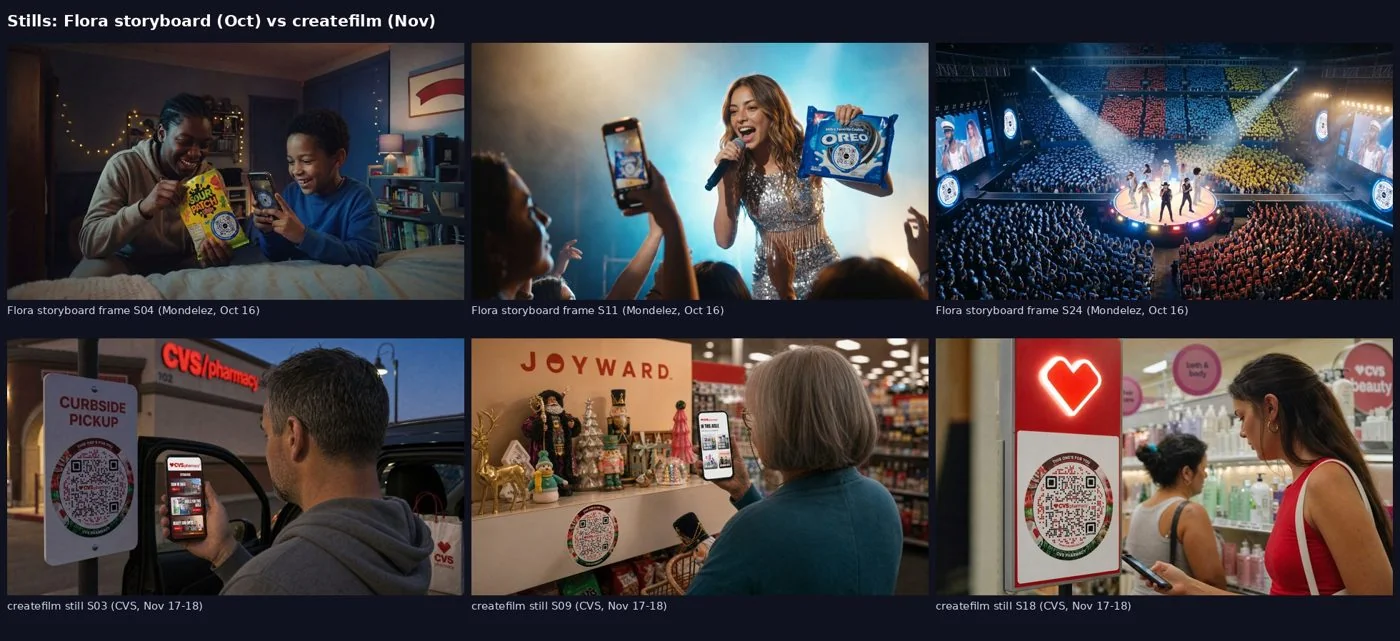
I set up a Flora project on October 15 and 16 and had my AI assistant drive Flora through its MCP connection, starting from a friend's Flora workflow tips: stills as key frames into Seedance, then the edit with Claude and Remotion. The board runs left to right by step, with the set-once groups at the top and one frame per step underneath, and four approval gates: G0 (assets missing, only if needed), G1 (I approve the storyboard before any video is generated), G2 (after lip-sync) and G3 (final).
Set once for all videos: the model choices; the band (seven members with reference packs, character sheets and Flora "Element" packs); prompt templates (Frame / Action / Camera, and a "sings with full mouth movement while dancing" line); a lyric look and a Remotion edit template; the tools (a demucs vocal split, Whisper word timings); and a generic Flowcode disc.
Redone for every video: the brand's inputs and real assets, the song map, shot list, storyboard, motion, review, lip-sync, cleanups, edit and lyrics.
The Mondelēz run (October 16 and 17).
- A 74.8-second song at 112 BPM in five sections (verse, chorus, verse, chorus, a rap finale), and a 33-shot list.
- The brief and real assets: a tagline ("Your touchpoints are naked: Flowcode dresses them up right"), about 25 real files (logos, pack shots, product cut-outs), 8 screenshots of the brand's own commercials (OREO "Twist, Lick, Dunk!", RITZ) and 8 concert references for the look.
- The storyboard: 33 frames from Nano Banana 2.1 at 2K, with GPT Image 2 fixing text the model had invented. I approved board v2.1 "as is" at G1 on October 16.
- Motion: 33 Seedance 2.0 clips, one per shot, with first-to-last-frame clips for the transitions.
- Lip-sync: Sync 3 on 19 singer shots. 8 were used, 3 were rejected after two takes because the wrong face was synced, and 8 had no visible effect on wide shots.
- The finished video became the "good example" in the storyboard kit, with its known flaws listed so contractors "copy only the good parts".
Why Flora was not the long-term path. At 500 companies, working on Flora directly was too slow and too expensive, though it was good for tuning the quality first. Driven headless through MCP, the board also could not make some node types, so we used workarounds (Element packs instead of Element nodes, "Split Text" instead of Batch).
Version 2: the Runway API pipeline
- The same pipeline, a new backend. On October 16 I wrote the Runway version of the workflow as a Claude Code skill: the same steps and rules, a model map from Flora to Runway, prompt templates and a small Python client. The client reads the key from the environment, refuses banned models and quotes every paid call before it runs. A second skill checks that a machine and its key are ready.
- The rules carried over. 1080p only; Flowcode with products in every shot; verses for customers and choruses for the band; singers sing and dance; no placeholders; each shot matched to its lyric; at most two regenerations before I choose; lyrics added last.
- The limits we found. Runway allowed three requests at a time, and the API refused a large share of photoreal frames.
- The lead's engine. His film scripts, and from November 1 one shared command, added seed review gates, clip QA (sharpness, frozen frames, energy, code scanning), a frame-exact review cut with a real-code end card, and cuts snapped to the beat.
The storyboard kit for contractors
On October 17 the lead asked the contractors to make storyboards (steps 1 to 6) for the songs with my pipeline.
- The kit. A skill covering the brief, the real assets (gate G0), the visual language, song timings, shot list and storyboard (gate G1). It has frame and board scripts that quote first, a quickstart, a one-page prompt a contractor pastes into Claude Code, and a tracker for 500 songs in blocks of 10 that syncs through Git without conflicts.
- Media stays out of Git. The reference images (seven band packs, concert stills, the generic disc, lyric stills) and the Mondelēz example live in a shared Drive folder that the kit links to.
- Gate G1. At first the storyboard stage stopped for the lead's approval. On October 19 it became a checkpoint: a contractor could go on to motion on their own "go", once the board was approved, the keys were set and each paid step was quoted.
- What the contractors added. Brand wardrobe and stage light for the band, likeness protection (blurring faces in reference photos, because the model copied real actors), pose, phone and disc checks, a brand kit that fetches a company's assets in seconds instead of about 10 minutes, and a realism rulebook: "real first, generate last".
The film recipe, and my rules on top
The lead's written film recipe (October 20, extended through November 9) describes how a song becomes a finished film:
- End card: the company's real code art, checked to scan; the one exception to "generate every code".
- Codes in shots: regenerate, never paste on top. A still must be an "A+" seed before it is animated.
- Band: the company's wardrobe and stage light, no more than five band shots, and Flowcode always on screen.
- Phones and checks: over-the-shoulder phone shots; every half second of the cut must move; each film passes clip QA.
- Edit: cuts snapped to the beat grid, frame-exact, and the end card built from the real art.
The November 19 upgrade built what the films had in common into the engine:
- Split motion. Shots with words on screen (a code, a phone, a page or artwork) run on Seedance 2; every other shot runs on Kling 3 Pro with the audio off and a short, busy prompt. Long scripted prompts and people with nothing to do had made motion look like AI: frozen grins, stage-direction acting.
- Motion advice before anything is generated. Each people shot needs a busy one-sentence action. Idle, scripted and mid-gesture shots are flagged and rewritten from the still.
- Never a still plate (my rule, below).
- Data beats from a reusable chart component (split, funnel, touchpoints).
- Karaoke on every sung line, kept off codes, phone screens and the numbers on data beats.
- Four advisory checks: nobody doing anything, two or more quiet chorus shots, a shot that is another brand's with the names changed, and disclaimer text in a scene.
My three rules on top (posted on November 16; rule 1 reworded on November 20 after the upgrade):
- Never a still plate. When Seedance refuses a shot, take one of the lead's routes instead of leaving a still frame in the film: kling (no words in frame), kling+decal (a code on a flat panel: run it on Kling, then lay the real code art back on) or reframe (a phone or page in frame: redo the still over the shoulder with no face toward the camera, then run Seedance again).
- Cut near-duplicate adjacent shots, and use the time to extend the neighbours or add varied shots.
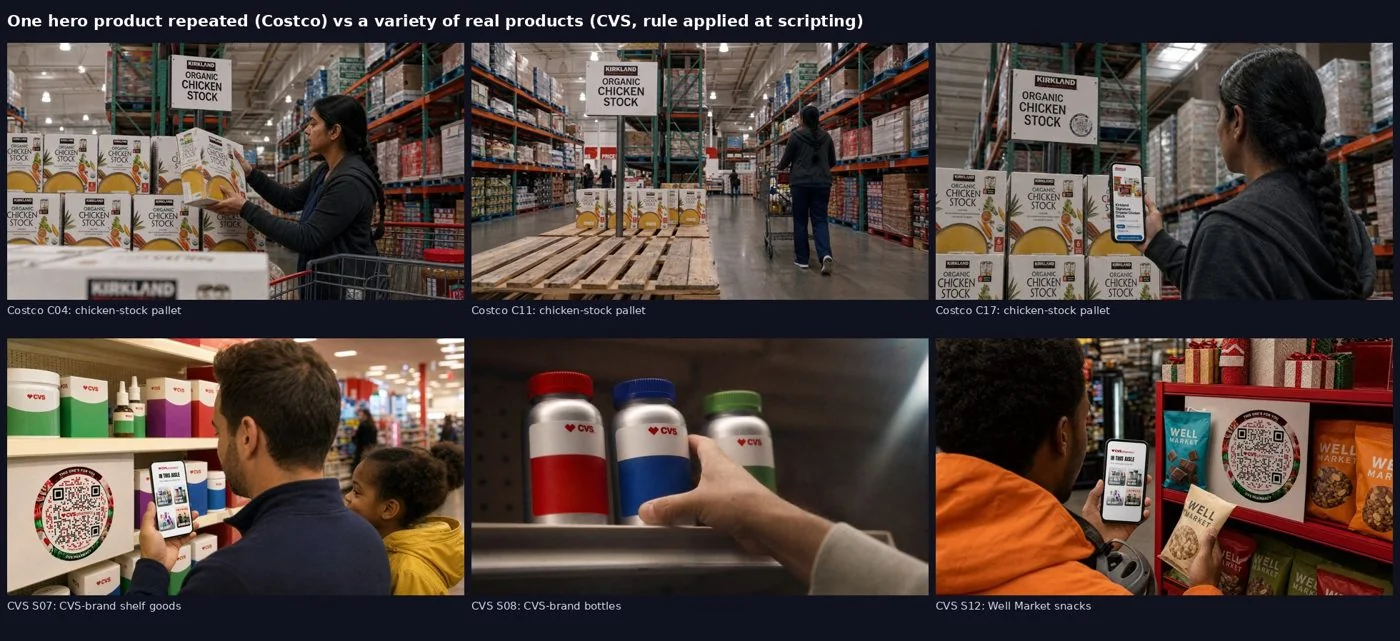
- At scripting, feature a variety of the company's real products. One hero product can carry the motif, but wides and backgrounds must show a mix.
Other standing choices. Lyrics are karaoke-style, word by word. On the CVS film I dropped the band in favour of more Flowcode infographics ("i would take out band and get more info graphic").
Case examples
0:09:40Before and after
Costco "One at a Time" (November 15 to 18)
- A 49.9-second film (a 46.87-second cut and a 3-second end card) on a soul song. One Saturday across one warehouse, with an ensemble of 15 people in 10 places and no single hero, following the verse: the membership card at the door, carts, Kirkland pallets, sample demos, the food court, rotisserie chickens, gas, checkout.
- The chicken stock moment (November 16). I asked why it was chicken stock in every Costco shot. The assistant admitted it was its own call and that it had gone too far: no lyric names chicken stock, and the story only needed one hero pallet whose sign changes over the film. My answer: "I would mix pallets and keep chicken stock as hero." The cut still uses the first wides; the principle became rule 3.
- Motion: 10 Seedance 2 shots (the code, phone and page shots) and 14 Kling 3 Pro shots where Seedance refused face-forward frames; one UI beat drawn by the kit; a generated end card with a live code that decodes.
- The second cut applied the new rules: a still plate was replaced by a Kling clip with the real code art laid back on, and a near-duplicate was cut for a new forklift shot. The lyrics were rebuilt as karaoke in Costco red.
CVS Pharmacy "Red Heart on the Beat" (November 17 and 18)
- A 55.3-second film (27 slots) on a country song. One rainy Friday across a neighbourhood and its CVS, with an ensemble of 12 people. The verses follow the customer's journey (the curbside sign, MinuteClinic, pickup, a seasonal display, the soccer field the store funds, the receipt). The choruses follow the marketer's: a plain aisle sign, then the same sign with the real Flowcode, scanned, signing in once.
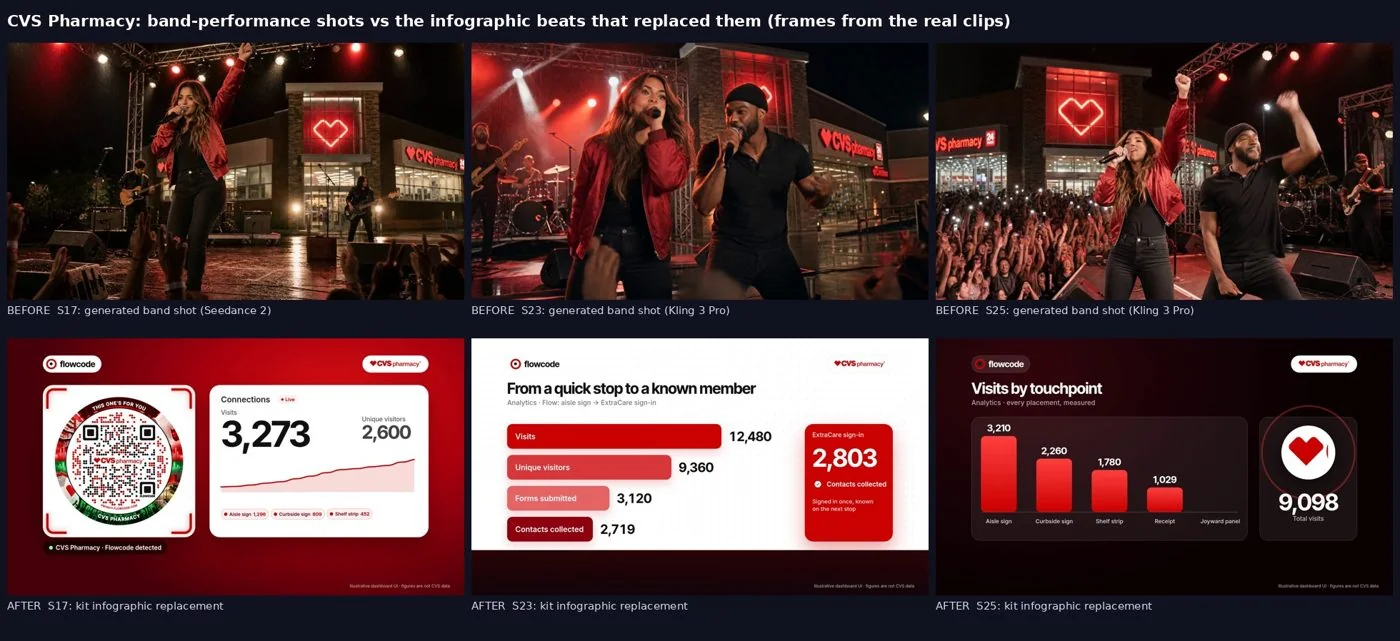
- 9 Seedance 2 shots and 13 Kling 3 Pro shots (two shots and the two-singer band shots fell back to Kling after Seedance's moderation refused them).
- The three band shots were replaced on November 18 by three Flowcode infographics rendered in HTML, at no generation cost: Connections, a funnel from visits to sign-ins, and "Visits by touchpoint" with a pulsing heart. The lead's reaction: "Those may be my fav ui graphics so far on the charts". The chart idea was reused in a later film.
- Two near-duplicate phone close-ups became one. The karaoke lyrics were corrected against the real lyrics (for example "Joywood" to "Joyward's").
Mondelēz (Flora, October 16 and 17)
33 shots and 74.8 seconds, built end to end on Flora: the first complete example, and the "good example" in the kit. See Version 1.
The other films
- Delta, Coca-Cola, Southwest (October 20 and 21): the first Runway films. My note: "the phone screens are amazing".
- Aflac (October 29): seven review cuts, and the source of the band cap and the Flowcode-on-screen rule.
- Walmart (October 29): a UI cut, with 11 shots on Kling after Seedance refused them.
- Heineken (October 17): a 22-shot Kling video made from real pub photos.
- Clorox, United, Spotify, Pepsi, Chevron, Mars: the team's films from October 30 to November 13.
Problems and fixes
0:12:02What went wrong, and what we did
| Problem | What happened | Fix |
|---|---|---|
| Waiting on keys | October 18 to 20: no Runway or ElevenLabs key yet, so nothing could be generated. | Kept making storyboards; the keys were set up by October 20. |
| Flora at scale | Too slow and too expensive for 500 companies; headless MCP could not make some node types. | The Runway version of the pipeline, and workarounds on Flora in the meantime. |
| Runway's limits | Three requests at a time; the API refused many photoreal frames. | Runs of three to four in parallel, a second route for refused frames, retry ladders. |
| AI-looking band shots | October 29: band shots "too fake/cringy", the wides most of all. | A cap of five band shots, brand wardrobe and stage light, face-blurred references; later UI or infographics instead of the band. |
| Not enough Flowcode on screen | October 29. | A check for Flowcode on screen. |
| Refusals leaving still frames | Seedance refused face-forward and two-singer shots on Costco and CVS; other films saw the same. | Never a still plate (rule 1): kling, kling+decal, or reframe and retry Seedance. |
| Kling's softness | Kling clips read softer, even "waxy". | Kling on quiet shots, Seedance kept for text, codes and screens; split motion now routes by shot type. |
| AI-looking people | Idle smiling; long scripted prompts acted out like stage directions. | Short, busy motion actions, advice before generation, a motion skill. |
| One hero product | The first Costco pass featured only two products. | Rule 3 (variety at scripting). |
| Near-duplicate shots | Two phone close-ups on CVS, two shots on Costco. | Rule 2 (cut, then extend or replace). |
| Wrong-face lip-sync | On Mondelēz, Sync 3 synced the wrong person on 3 shots and did nothing on wide shots. | Lip-sync only on single-face singer shots; later, other lip-sync routes in the engine. |
| Lost work | Job receipts lost with a temporary folder; a machine restore wiped the first CVS renders. | Cuts rebuilt from committed scripts; never work in a temporary folder; keep logs with task ids. |
| Many approaches | "Fragmentation across our approaches" (November 1). | One shared film pipeline. |
| Media in Git | Repository limits. | Media kept out of Git; cuts shared through Drive; the kit's media in a Drive folder. |
Results and lessons
0:13:34Results
- One complete Flora video (Mondelēz), used as the reference example.
- A reusable storyboard kit used by all three contractors, with an ownership tracker for 500 songs.
- A shared, written film recipe and one film pipeline with automatic checks and QA gates.
- Two full films on that pipeline, Costco and CVS, with karaoke lyrics, real end-card codes that decode, and no still plates. Both were merged into the shared pipeline on November 19.
- A reusable Flowcode chart component and a new default motion policy, both now in the engine.
- The team's feedback on the UI graphics: "my fav ui graphics so far".
Lessons
- Prove the process on one video, then write it down. The Mondelēz run became the kit's example, and the recipe turned into checks and QA gates.
- Gate the expensive step. Storyboards are cheap and motion is most of the bill, so approve the board before any video is generated (G1), and quote before every paid step.
- Real beats generated. Real photos, real packaging and real codes made the biggest difference to quality. Generated band shots were the biggest risk.
- Have a fallback for moderation. A refusal that quietly leaves a still frame ruins a film: fall back to another model and check that every shot moves.
- Graphics that cost nothing beat weak generated shots. The infographics replaced a weak band.
- Keep media out of Git, and keep logs. Task ids in a log made recovery after lost files possible.
- Write the rule when a pattern repeats. My three rules came from the Costco pass and the lead's feedback; the motion split is the same pattern.
- Standardise early. The November 1 clean-up came after weeks of separate approaches.
- Move what several films share into the engine. The November 19 upgrade turned the weaknesses the films had in common into checks and defaults.
The credits · back of the box
Flowcode Touchpoints Music Videos
- Workflow, kit and films
- William Yao
- Made for
- Flowcode
Flora · Runway API · Seedance 2 · Kling 3 Pro · Nano Banana · GPT Image 2 · Sync 3 · Claude Code · Remotion
Not rated · Reading time 15 min